
Davidson County Directory Landscape
Davidson County has no single official name finder. Its people directories answer narrow questions: who serves on a Metro staff, who works at a school, who owns a parcel, who signed a deed, who holds a state credential, or who lived at an address decades ago. Start with the directory whose reason for listing a person matches the fact being checked.
| Name source | People represented | Record keeper | Practical access |
|---|---|---|---|
| Metro Council roster | Council personnel | Metropolitan Council | Free static page |
| General Assembly directory | Legislators and staff | Tennessee General Assembly | Free A to Z browse |
| MNPS school directories | Faculty and school staff | Individual schools | Free school pages |
| Parcel Viewer | Current property owners | Metro GIS and Assessor | Free name or address search |
| DavidsonPortal | Recorded grantors and grantees | Register of Deeds | Account portal or office terminals |
| Nashville city directories | Past residents and firms | Metro Archives | Reading room and staff help |
Use a public roster for an official role and a school page for an educator. Property systems list owners, not all occupants. The deed index lists parties to instruments, not everyone who lived on the land. Historical directories can bridge an old name and street, while yearbooks and archives add school or community ties. Each hit must be read in the context of why that source was made.
Davidson County Government Directories
Nashville and Davidson County have shared a consolidated metropolitan government since 1963. Current rosters therefore tend to live on Metro department pages rather than in separate city and county directories. There is no verified master Metro employee search. The Metro Council staff roster is a static list with each person’s full name and role. Its shared contact is the Historic Metro Courthouse, 1 Public Square, Suite 204, Nashville, TN 37201, at 615-862-6780.
The official Council roster shows the page style used for named Metro personnel:
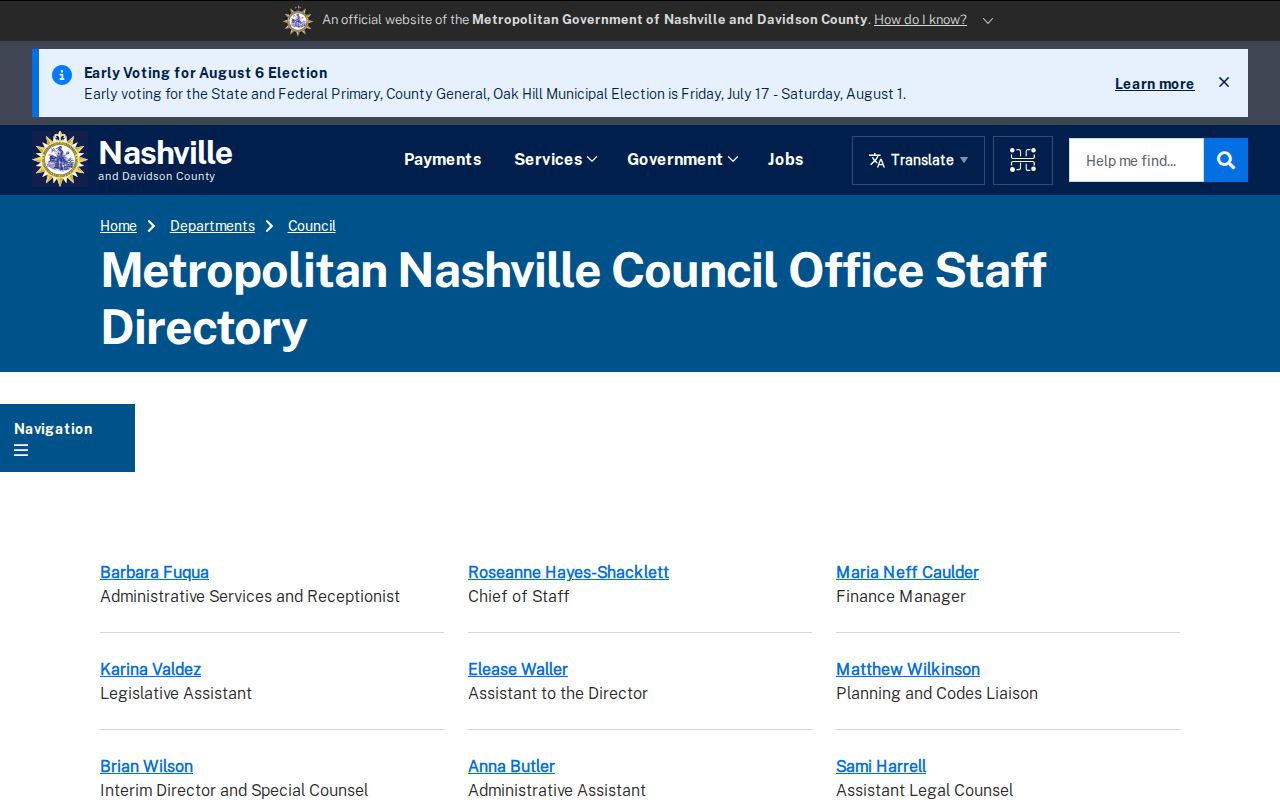
The capture makes clear that a static roster may be useful even without filters or export tools. When a person is missing, open the relevant department page or call its main line. Metro Clerk is the recordkeeper for council and legislative material, while specialized offices use their own records processes.
| Person | Full name as published |
|---|---|
| Role | Staff title or public function |
| Unit | Department, council, chamber, or office context |
| Contact | Published office phone or shared main line |
| Place | Government building or room when supplied |
Davidson County State Staff Directory
Nashville is the state capital, so state rosters are especially useful local people directories. The Tennessee government directory points to agencies, public contacts, local government sites, officials, law enforcement, and legislators. The General Assembly directory provides the most clearly documented staff browse. It includes legislators, assistants, analysts, press staff, and other personnel.
| Directory control or field | Type | What it does |
|---|---|---|
| A to Z letters | Browse control | Narrows entries by name |
| Name | Result field | Identifies the listed person |
| Position | Result field | States the legislative role |
| Location or chamber | Result field | Places the person in the institution |
| Office or room | Result field | Gives the public office location |
| Phone | Result field | Supplies the work contact |
Addresses in this directory are standardized to Nashville 37243. That office address identifies a work site, not a private residence. For an agency employee who does not appear, use the agency’s public contact page or the state directory hub rather than inferring a personal address from another source.
Davidson County School Directories
Metro Nashville Public Schools uses school-by-school directories. The documented entries normally give a staff member’s name and title; the research did not confirm a districtwide search. Select the school first, then inspect its staff page. This structure helps distinguish two people with similar names because the institution and role travel with the entry.
The MNPS staff directory source shows how the school system presents its directory route:

The captured page supports a school-first search rather than a claim that one countywide form reaches every teacher. For older education ties, Metro Archives holds Nashville and Davidson County yearbooks from elementary school through college across 1900 to 2017. University archives at Vanderbilt, Fisk, Belmont, and Tennessee State may also hold catalogs, yearbooks, commencement programs, newspapers, and faculty directories. Ask for public archival material, not private current alumni data.
Davidson County Property Owner Directories
The free Metro Parcel Viewer acts like a current owner directory. It searches by parcel address or intersection, current owner name, street name, parcel ID, description, city, ZIP, acreage, sales range, zoning, or a custom map shape. Results can expose ownership and property history, assessment data, zoning, and permits. Metro says the viewer updates daily.
A name hit means the assessment system ties that owner to the parcel. It does not prove that the owner lives there. A mailing address is where tax correspondence goes, while a situs address is the physical parcel. They may differ. The map is also informational rather than a legal title opinion. Confirm ownership with the recorded deed when that distinction matters.
Counter help remains available from the Assessor at the Howard Office Building, Suite 210, or by phone at 615-862-6080. The Mapping Division answers at 615-862-7175. When the viewer lacks a desired field, request the existing Property Record Card instead of asking staff to create a new analysis.
Davidson County Deed Party Directory
The Register of Deeds index works as a grantor and grantee directory. A grantor transfers an interest; a grantee receives it. DavidsonPortal’s electronic name and date index begins July 1, 1964, while document images reach 1784. Lot, subdivision, and document-type searching begins January 1, 2000. Those different dates explain why an old image can exist even when a modern name search returns nothing.
Use the DavidsonPortal land-record entry for online access. Public computers at 300 Deaderick Street offer the key fallback, and staff provide a short tutorial. Archive index books bridge older names. Mail requests can use a property address for a deed or detailed index facts for another instrument, along with a self-addressed stamped envelope and payment. Metro Archives and Tennessee State Library and Archives microfilm extend the historical path.
Recorded parties are not always residents. Deeds, trusts, liens, powers of attorney, plats, releases, and recorded wills serve different legal purposes. Read the instrument type before treating a name as an owner or occupant.
Davidson County Professional Directories
Tennessee professional and business systems group people by legal role or credential. The Secretary of State business search can show an entity’s legal name, status, jurisdiction, control number, principal office, registered agent, and filing history. An agent accepts legal service and is not necessarily an owner. The separate UCC system lists debtors and secured parties, but an old filing address may not be current.
The Health Related Boards license search verifies health credentials. Commerce and Insurance covers fields such as contractors, appraisers, real estate, architecture, engineering, alarm systems, protective services, cosmetology, funeral services, insurance, and securities. Search modes include an individual or business name, a name within a license type, license number, city, Davidson County, or license category. Results show status, expiration, and public discipline. Preserve exact terms because expired, inactive, retired, suspended, and revoked do not mean the same thing.
Attorneys have a separate Board of Professional Responsibility directory. Alcohol records split again between state TABC license types and local Metro beer permits. These people directories verify a published role; none alone proves a home address or business ownership.
Davidson County Historical Directories
Metro Archives genealogy collections preserve Nashville city directories from 1853 through 2011, while the library collection policy documents the long-running local directory collection. The arrangement is the key detail. Volumes are name-oriented through 1909, then become useful for street-address and reverse searching from 1910. A reverse directory starts with an address and identifies the listed person or firm, the opposite of a standard name lookup.
- 1853
- The documented Nashville city-directory run begins.
- 1909
- Name-first use remains the practical approach through this year.
- 1910
- Street-address and reverse directory research becomes available.
- 1963
- Metro consolidation changes how later government labels appear.
- 2011
- The specifically documented local run ends.
Pre-1963 volumes did not cover all modern Davidson County in the same way. Search Nashville plus the historical community, ward, or institution. Belle Meade, Forest Hills, Oak Hill, Berry Hill, and part of Goodlettsville kept municipal identities, while Donelson, Hermitage, Madison, Antioch, Bellevue, Old Hickory, and Joelton can appear under community names.
Davidson County Cemetery Directories
The Nashville City Cemetery interment database covers 1846 through 1979 and about 20,000 burials. Its earlier 1822 through 1846 books were lost during the Civil War. Later interment books, inscription and obituary indexes, the 1909 List of the Dead, lot cards, post-1979 burials, and cemetery deed books partly rebuild the missing trail.
Lot cards add a subtle relationship that an ordinary directory misses. They can identify the lot owner, location, purchase date, people buried there, and often a grave plat. The owner and interred person may differ, revealing a family or associate link. Transcripts retain sextons’ spelling errors, so try variants before concluding that a name is absent.
The Nashville Globe obituary index, city and county death series, cemetery sources, and funeral material cover different gaps. Davidson surname PDFs cover county deaths from 1900 through 1913, while the online city transcription for 1874 through 1904 reaches only surnames A through B. The full city index survives on microfilm.
Davidson County Archive Directories
Nashville Public Library Special Collections holds far more than items visible in a catalog. Noncirculating and closed-stack sources include biography ephemera, maps, newspapers, funeral programs, family histories, copied deeds and marriages, oral histories, and yearbooks. Digital collections add City Cemetery lot cards, Nashville Banner photographs, veterans’ accounts, civil-rights and Music Row interviews, and “Nashville’s New Faces” oral histories from immigrants and first-generation residents connected with 27 countries.
Metro Archives
City directories, yearbooks, vital indexes, wills, courts, cemetery, naturalization, maps, and newspapers.
Special Collections
Closed-stack research by application. Call 615-862-5782 with name variants, dates, neighborhood, and institutions.
Digital Collections
Browse selected photographs, lot cards, oral histories, maps, and local documentary collections.
During the 2025 Main Library closure, Metro Archives used its Elm Hill Pike storage work to digitize subdivision plats, process Guardian Settlement books, and inventory newspapers against digital coverage. The work confirmed that the web is not the whole directory. Donelson News Diary, Nashville Record, Jeffersonian, and Evening Tennessean holdings were among the titles under review.
A focused staff request works best. Give surname variants, an approximate date, a neighborhood or old address, an institution, and known relatives. The 1908 G.M. Hopkins Atlas can also translate a directory street into mapped lots, building footprints, institutions, rail lines, and streetcar routes. A catalog no-result is not proof that the archive has no record.